 Students Incorporated
Education
The Case for Teaching STEM Identity, Not Just Code
As AI writes its own code, Smart Lab CEO Dr. Jennifer Berry argues K-12 STEM education should build belonging and confidence, not just technical skill.
Ask Dr. Jennifer Berry what schools should be teaching kids about STEM right now, and she doesn't start with coding. That's a deliberate choice, and it puts her in the middle of one of the more uncomfortable debates in education: what happens to STEM instruction once the machines can do the STEM.
Berry is the CEO of Smart Lab, a K-12 program built around hands-on, project-based learning in science, technology, engineering, and math. In an interview on Students Incorporated, she laid out a bet that runs directly against the moment we're in: as artificial intelligence gets better at writing code, running experiments, and crunching data, the point of STEM education isn't the code anymore. It's what she calls "STEM identity": whether a student believes they belong in a technical field, can push through a hard problem, and can make something that matters. Code is just the material they use to get there.
The Machines Are Already in the Lab
The tension isn't hypothetical, and the episode itself supplied the evidence. In its headline news segment, the show reported that researchers at the Max Planck Institute in Munich had unveiled an AI-powered lab assistant capable of autonomously planning, running, and adjusting chemistry experiments in real time, aimed at materials science and pharmaceutical research. Early tests reportedly showed the system completing multi-step synthesis in half the time a human researcher needs, while cutting resource waste by up to 40 percent.
That's not an outlier. Self-driving laboratories, systems that combine AI with robotics to run the entire experimental cycle from hypothesis to conclusion, have moved from academic novelty to something closer to industrial infrastructure over the past couple of years. Chemical & Engineering News reported this year that these systems are changing how chemists actually work, and Argonne National Laboratory now runs a dedicated Autonomous Discovery program that pairs machine learning with free-roaming lab robots to handle experiments end to end. The pitch is the same one Berry's headline segment described: let the AI handle the repetitive, technical execution, and free up humans for judgment calls the software still can't make.
It's the same logic Nvidia CEO Jensen Huang used in 2024 when he told an audience at the World Government Summit in Dubai that children shouldn't bother learning to code, arguing AI had made programming languages obsolete in favor of plain human speech. The comment landed hard and still circulates in education and tech circles as shorthand for a real anxiety: if a machine can write the function, what exactly are we training kids to do?
Berry's Answer: Identity, Not a Skill Set
Berry doesn't dispute the premise. "Gone are the days where you actually needed to know how to code, where you need to know how to do basic applications, because AI can actually do those things for you," she said. Her argument is that this makes the old goalpost, technical proficiency, the wrong thing to chase in the first place. What Smart Lab is built to produce instead is what she calls STEM identity: a student's belief that they belong with STEM applications, can master a rigorous challenge, and that their ideas carry weight.
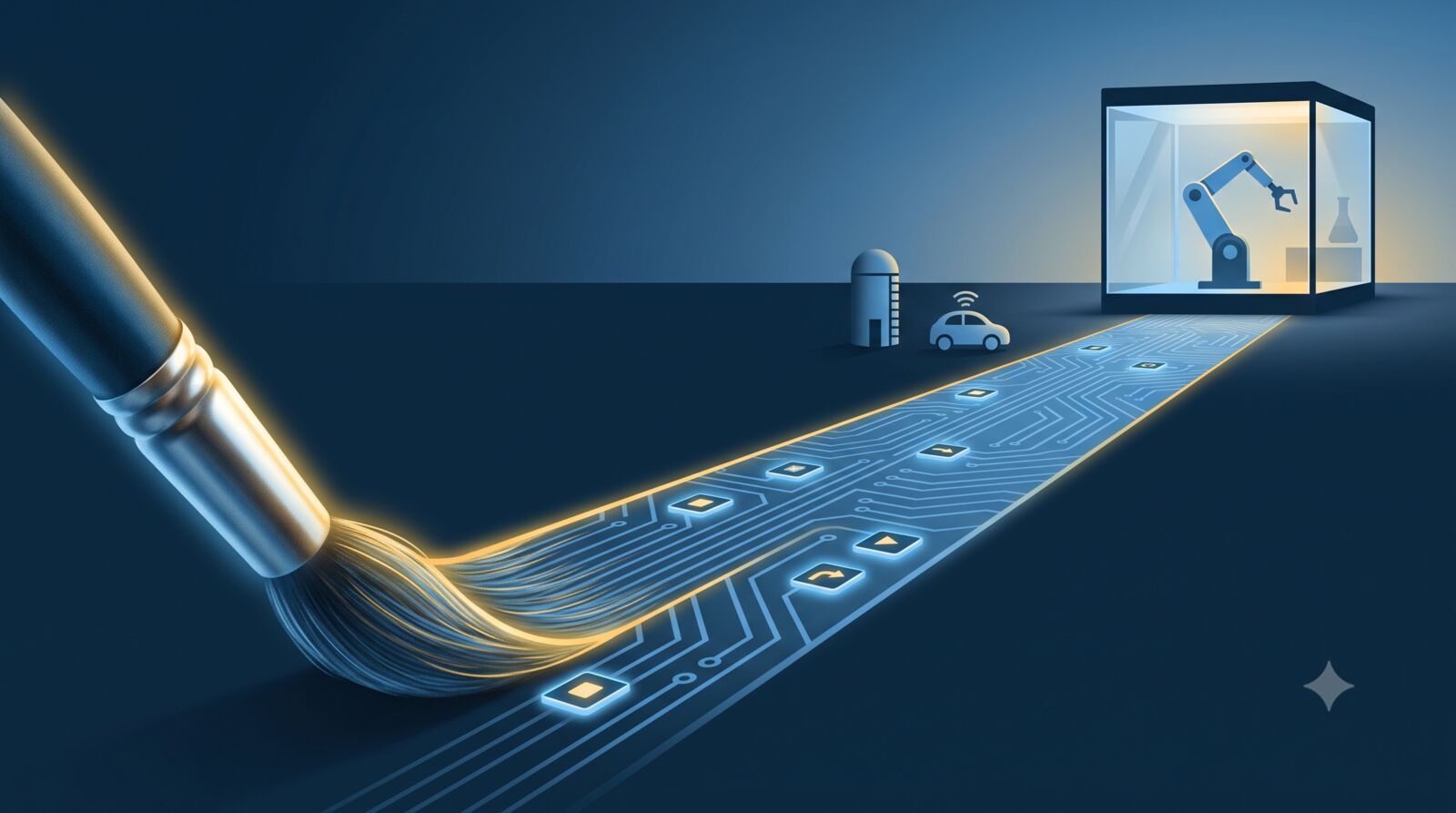
Technology is actually a canvas. It's the paintbrush, not the painting.
That framing isn't just branding. STEM identity is an active research construct in its own right; an NSF-funded structural model of the concept, published through the National Science Foundation's PAGES repository, defines it around a student's sense of recognition, competence, and belonging in a technical field, not simply their grade in a science class. Belonging, in that literature, functions less like a nice-to-have and more like the load-bearing wall of whether a student sticks with a field at all.
Smart Lab's practical answer is what Berry describes as an integrated ecosystem: a hands-on, career-connected physical environment; a curriculum built for students to "fail forward"; facilitators trained specifically not to hand over answers but to sustain what she calls "productive struggle"; and a support structure that pulls the surrounding community into the process. The company runs programs from kindergarten through 12th grade.
What "Fail Forward" Looks Like at Five
The clearest illustration Berry offered was a kindergarten unit called Harvest Holler, which teaches four- and five-year-olds to code using physical tiles: red for stop, green for go, yellow for pause, arrows for turning. On its own, that's a fairly standard early-childhood coding exercise. What Smart Lab adds is a real-world frame layered on top: the same coding logic gets applied to programming a self-driving car, and then to tracing how food moves from a farm to a farmer's market to a grocery store to a family's kitchen table.
The point, Berry said, isn't that five-year-olds are becoming programmers. It's that they're building an early, concrete connection between an abstract skill and a reason to use it, a habit the curriculum then scaffolds up through building sensor-equipped robots by middle school and AI-driven systems by high school.
The Bottleneck Isn't the Students
Asked what actually blocks STEM education from working at scale, Berry didn't point to student motivation or funding for equipment. She pointed to teacher capacity. "Teachers are stretched really thin," she said. "Resources are limited. The pace of change in technology is happening at lightning speed."
The data backs her up. The Learning Policy Institute's 2025 teacher shortage analysis found at least 411,549 U.S. teaching positions either unfilled or staffed by someone not fully certified for the role, roughly one in eight positions nationwide, with science and math among the most commonly cited shortage areas by state education agencies. A teacher already managing an oversized class and an uncertified assignment has little bandwidth left to independently master a new AI tool before deciding whether to bring it into a lesson. Smart Lab's pitch is to remove that decision from individual teachers by pre-building a "turnkey and sustainable" system, so the teacher's job becomes guiding students through it rather than keeping pace with the technology underneath it.
Measuring What Doesn't Show Up on a Test
Berry is upfront that Smart Lab's real metric isn't standardized test scores. It's a shift she can only measure by asking students directly, before and after a program, how confident they feel tackling a hard problem and whether they see themselves belonging in a STEM field. "For us, success looks like a student saying, I didn't think I could do that, but now I know I can," she said.
That's a harder thing to point to than a percentile score, but it isn't unmeasured territory. A 2026 study in the journal Humanities and Social Sciences Communications, examining project-based learning's effect on academic outcomes across multiple prior studies, found an overall effect size of 1.11, with a 0.66 effect specifically in math instruction, alongside gains in scientific process skills and social competencies compared with traditional instruction. Berry's emphasis on confidence and belonging rather than raw scores lines up with what that research keeps finding: the hands-on, iterative structure changes how students relate to the subject, which is a precondition for the scores improving, not a substitute for them.
What the Job Market Is Actually Asking For
Berry's case for skills over syntax also lines up with what employers say they want. A 2026 Graduate Management Admission Council survey of 600 corporate recruiters found that communication, problem-solving, adaptability, data analysis, and teamwork topped their hiring priorities, well ahead of narrow AI skills, which ranked 14th, up only slightly from 16th the year before. The message from employers isn't that technical fluency doesn't matter; it's that in a market where AI is doing more of the technical execution, the differentiator has shifted toward judgment, adaptability, and the ability to solve a problem nobody has fully defined yet, exactly the muscles Berry says Smart Lab is built to train.
Her framing of who's in charge of that shift is unambiguous. "Students who learn to have AI serve them, not the other way around, will be the leaders of the future," she said, adding that she sees far more fear of AI among adults than among the students living through the transition. Whether that confidence holds up as the technology keeps moving is an open question. But Berry's bet is that a student who's already failed at something hard, worked through it, and come out the other side with an idea that mattered, has a head start no chatbot can hand them.